


Lithium-Ion Battery Separator Market Share Landscape Expands Toward USD 24.3 Billion by 2030
Market Overview and Growth Outlook
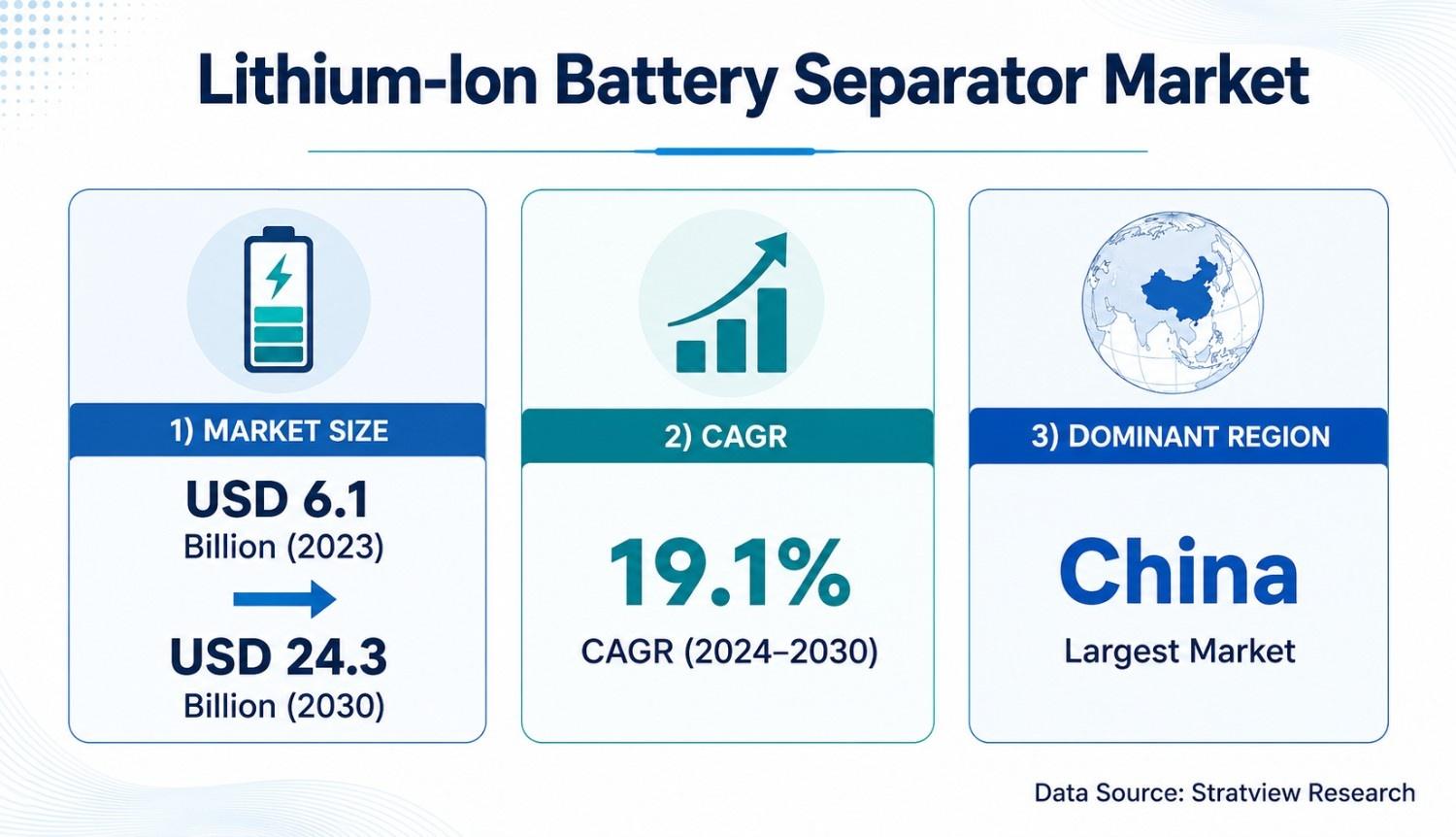
The global Lithium-Ion Battery Separator Market is positioned for substantial expansion through 2030. Valued at an estimated USD 6.1 billion in 2023, it is likely to reach USD 24.3 billion by the end of the forecast period. The expected 19.1% CAGR during 2024–2030 reflects rising battery demand and increasing separator performance requirements.
“The Lithium-Ion Battery Separator Market is expected to grow at a CAGR of 19.1% during 2024–2030.” The separator is an essential battery element because it keeps the positive and negative electrodes apart while enabling ions to travel between them. This dual requirement links separator quality directly to safe operation, battery efficiency, durability, and thermal performance.
Assessment of Lithium-Ion Battery Separator Market share shows leadership concentrated across Automotive, PE, Wet, Films, and China within their respective market categories. The broader growth trajectory is supported by electric vehicles, energy storage solutions, consumer electronics, battery technology progress, safety regulations, and initiatives to enhance battery performance while lowering costs.
Request a free sample report:
https://www.stratviewresearch.com/Request-Sample/lithium-ion-battery-separator-market#form
Market Segmentation Analysis
The End-Use Industry Type segmentation includes Automotive, Industrial, and Consumer Electronics. Automotive accounted for the largest market share and is expected to remain the leading segment. Industrial is projected to grow fastest. Automotive demand is linked to EV battery packs, while industrial demand is associated with energy storage, automated and robotic manufacturing, renewable integration, and sustainability.
The Material Type segmentation includes PE (UHMWPE and Others), PP, and Others. PE accounted for the largest market share and is expected to remain the most preferred material. High porosity, mechanical strength, purity, chemical and thermal stability, and low electrical conductivity allow PE separators to support efficiency, safety, longevity, energy density, and battery power requirements.
The Medium Type segmentation includes Dry and Wet. Wet accounted for the largest market share and is likely to remain both dominant and fastest growing. Low separator thickness can improve volumetric energy density, while wet-separator electrolyte and thermal characteristics support higher energy densities, faster charging rates, longer cycle life, and reliable performance in electric vehicle battery systems.
The Separator Type segmentation includes Films and Nonwovens. Films accounted for the largest market share and are expected to remain dominant, whereas Nonwovens are estimated to grow faster. Films combine uniform structure, controlled pores, strength, chemical resistance, and manufacturing maturity. Nonwovens can enhance ionic conductivity and electrolyte retention through greater engineered porosity and tortuosity.
Regional Market Insights
China is expected to maintain the largest regional market share. The country has extensive battery and component production infrastructure, numerous manufacturing facilities, efficient processes, and scale economies. It also represents a major market for electric vehicles, consumer electronics, and energy storage systems, creating substantial demand for batteries and the separators required in every lithium-ion cell.
North America is expected to record the highest regional growth. A significant surge in electric vehicle adoption is increasing battery demand, while major separator manufacturers are opening plants within the region. These two developments strengthen local supply and demand simultaneously, supporting a higher growth rate during the forecast period.
Emerging Trends Shaping the Lithium-Ion Battery Separator Market
Super-thin separator development is advancing for high-power lithium-ion battery systems. A stated commercial product uses a 16.51 μm, two-sided adhesive-coated PP/PE/PP trilayer membrane. Heat- and pressure-activated adhesion supports electrode-separator bonding, while improved wettability, lower resistance, interface stability, high-speed lamination suitability, and enhanced cycle life address both battery performance and assembly requirements.
Next-generation cooperation is also expanding across materials and application technologies. Recent collaboration areas include advanced adhesion, controlled deposition and coating, low-temperature assembly, and semi-solid battery manufacturing. These developments indicate that separator innovation increasingly involves integrated material-process engineering rather than isolated changes to membrane composition or physical structure.
Key Growth Drivers of the Market
- Automotive battery volumes: EV production increases demand for multicell battery packs, creating a direct requirement for large quantities of separators.
- Industrial energy requirements: Storage systems, automation, robotics, and renewable integration expand the use of lithium-ion batteries in industrial environments.
- Consumer battery applications: Portable electronics rely heavily on rechargeable lithium-ion cells, maintaining established separator demand.
- Advanced cell specifications: Higher energy density, faster charging, and longer operating life increase the need for technically advanced separator materials.
- Thermal and electrical safety: The requirement to prevent electrode contact and withstand operating heat drives adoption of stable, insulating, and flame-resistant separator technologies.
Competitive Landscape
Top Companies in the Market
- SEMCORP Group
- Shenzhen Senior Technology Material Co., Ltd.
- Asahi Kasei Corporation
- Sinoma Science & Technology Co., Ltd.
- SK Innovation Co., Ltd.
- Toray Industries
- UBE Corporation
- ENTEK International
The market’s fewer than 50 global players create a highly consolidated competitive structure. Price, service offerings, and regional presence are identified as governing factors. As battery production expands geographically, competitive positioning remains connected to commercial responsiveness, manufacturing economics, market access, and the capacity to meet evolving separator-performance specifications.
Conclusion and Strategic Outlook
The Lithium-Ion Battery Separator Market is projected to grow from USD 6.1 billion in 2023 to USD 24.3 billion in 2030 at a CAGR of 19.1% during 2024–2030. The forecast is supported by multiple battery-dependent industries and the separator’s central contribution to electrical insulation, ion transport, thermal stability, safety, and battery life.
Market-share leadership is expected to remain with Automotive, PE, Wet, Films, and China in their respective categories. North America will likely provide the highest regional growth, while Industrial and Nonwovens represent faster-growing segments. Strategic industry development will remain centered on material performance, reduced thickness, advanced adhesion, improved electrolyte behavior, flame resistance, cost control, and scalable regional production.
FAQs – Lithium-Ion Battery Separator Market
1. What is the value forecast for the Lithium-Ion Battery Separator Market?
The market is forecast to reach USD 24.3 billion by 2030, compared with USD 6.1 billion in 2023. The increase represents significant growth over the forecast horizon.
2. What is the expected market CAGR?
The Lithium-Ion Battery Separator Market is expected to expand at a CAGR of 19.1% during 2024–2030. This rate is based on the stated global market forecast.
3. Which drivers are increasing separator demand?
Electric vehicle expansion, renewable storage deployment, consumer electronics use, industrial battery applications, battery advancements, safety rules, and cost-performance efforts are driving demand. These factors increase battery-cell production and the need for reliable separators.
4. Which region leads the market share?
China is expected to retain the largest market position through the forecast period. North America is expected to achieve the highest growth rate.
5. What risks and opportunities define the competitive landscape?
Opportunities arise from strong forecast growth, higher battery demand, and continuing separator innovation. Risks include demanding safety and material-performance requirements, cost competition, and a highly consolidated landscape where service offerings and regional presence affect competitive positioning.

 English
 Arabic
 French
 Spanish
 Portuguese
 Deutsch
 Turkish
 Dutch
Dutch
 Italiano
 Russian
 Romaian
 Portuguese (Brazil)