


How a Custom Router Bit Manufacturer Solves Real Production Problems
Most discussions about custom tooling stay abstract — better precision, tailored geometry, and so on. This one focuses on the concrete production problems that push manufacturers toward custom bits in the first place, and what actually gets resolved once they make that switch.
The "Almost Right" Bit Problem
A lot of manufacturers spend years running a stock bit that's almost right for the job — close enough diameter, similar flute geometry, workable but not ideal. It's a quiet inefficiency that's easy to tolerate because switching feels like more trouble than it's worth. But "almost right" tooling tends to show up as slightly shorter tool life, occasional finish issues that need rework, or feed rates kept conservative to compensate for a bit that isn't quite optimized. Custom tooling built around the exact job removes that daily compromise.
Solving Material-Specific Cutting Challenges
Some materials just don't behave well with generic tooling — certain composites that delaminate, dense hardwoods that burn at standard feed rates, or coated panels where standard bits chip the surface layer. A manufacturer capable of custom grinding can adjust flute geometry, rake angle, and coating specifically for that material's behavior, something a catalog of pre-made bits simply can't offer since it's designed around average-case performance rather than your specific edge case.
Reducing Secondary Finishing Work
When a bit doesn't quite match the job, the cost often doesn't show up as a tooling expense — it shows up downstream as extra sanding, edge cleanup, or rework that a properly matched bit would have avoided entirely. Custom tooling designed to leave the correct finish straight off the machine can meaningfully cut labor time spent on secondary processing, which is a cost that's easy to overlook when comparing bit prices in isolation.
Standardizing Across Multiple Machines or Shifts
Manufacturers running several CNC machines, sometimes across different shifts or even different facilities, benefit from custom bits designed to perform consistently across that whole setup rather than tuned informally, machine by machine. This kind of standardization is difficult to achieve with off-the-shelf tooling sourced inconsistently over time, but becomes straightforward when working with a single manufacturer producing to a fixed specification.
Getting Started Without Overcommitting
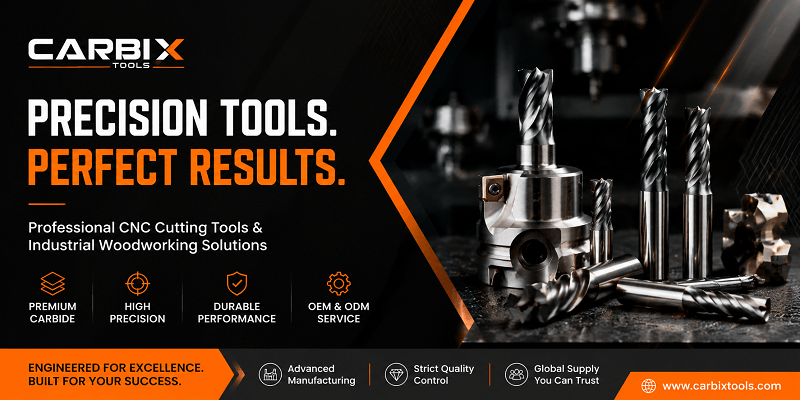
Manufacturers new to custom tooling don't need to convert their entire operation at once. A sensible approach is starting with the single job causing the most friction — the material that dulls bits fastest, or the profile that's hardest to source — and testing custom tooling there before expanding further, an approach reflected in how Carbix Tools works with manufacturers on custom CNC router bit solutions.
www.carbixtools.com is a professional Straight & Spiral Router Bits Manufacturer specializing in high-performance cutting tools for woodworking, CNC machining, and industrial applications. Carbix CNC straight router bits are designed with precision grinding technology and premium carbide materials to provide clean cuts, stable performance, and long service life. We supply various router bit solutions for furniture manufacturing, cabinet making, plastic processing, and general woodworking projects.
FAQs
How do I identify which job is the best candidate for custom tooling first?
Look for the job with the highest tool replacement frequency or the most secondary finishing work — that's usually where custom tooling shows the fastest return.
Will switching to custom bits require retraining machine operators?
Generally not significantly — custom bits are typically designed to run on existing machine setups, though feed rates and speeds may need minor adjustment during initial testing.
How long does it usually take to see a measurable difference after switching to custom tooling?
Most manufacturers notice a difference within the first few production runs, particularly in tool life and reduced rework, though full cost benefits become clearer over a longer production cycle.

 English
 Arabic
 French
 Portuguese
 Deutsch
 Turkish
 Dutch
Dutch
 Italiano
 Russian
 Romaian
 Portuguese (Brazil)
 Greek
Greek