


Aerospace Bearings Market Share Dynamics Support USD 2.6 Billion Forecast by 2032
Market Overview and Growth Outlook
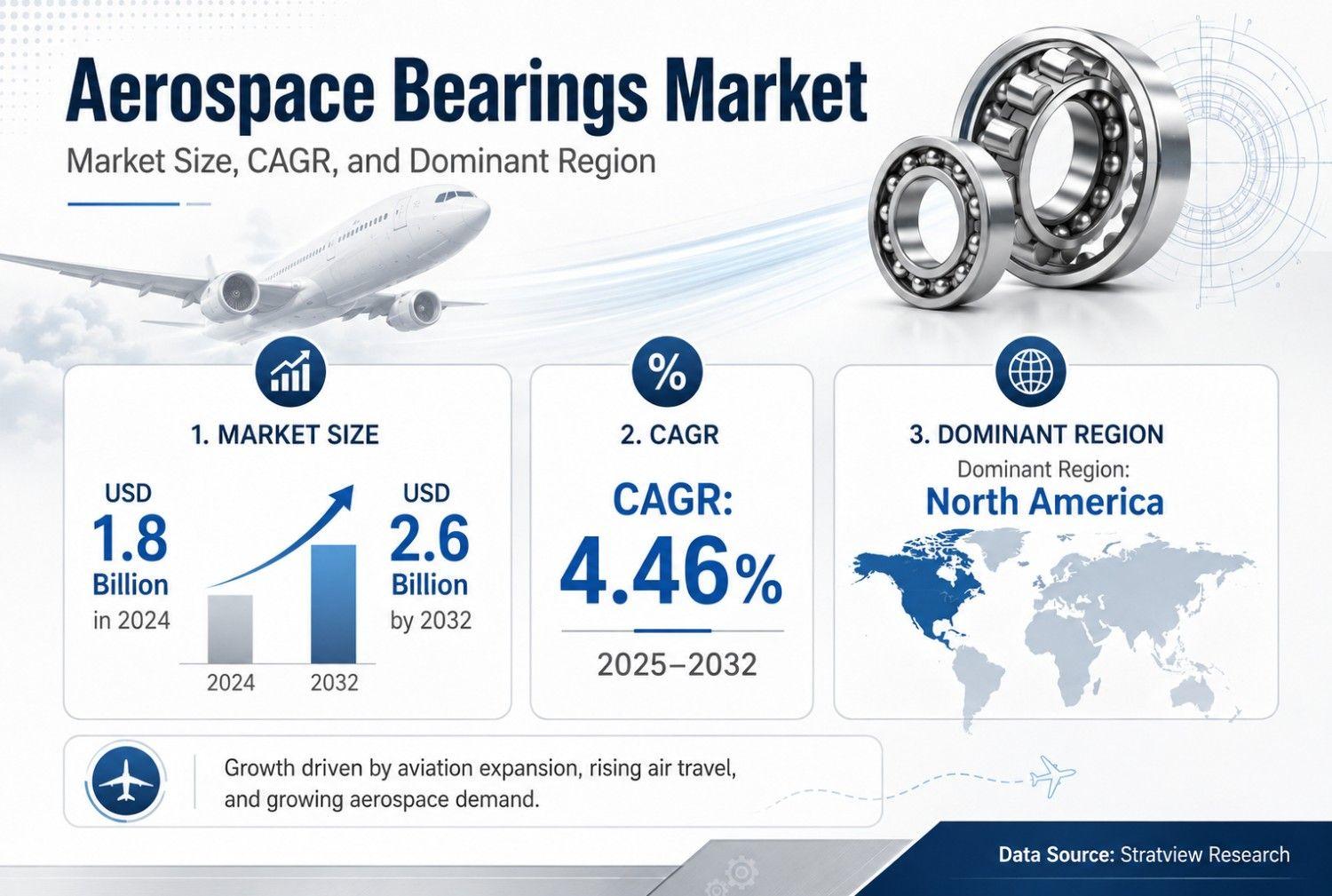
The Aerospace Bearings Market was valued at USD 1.8 billion in 2024 and is projected to attain USD 2.6 billion by 2032. The market’s 2025–2032 growth trajectory reflects the expansion of aviation, increased passenger travel, recovering aircraft deliveries, military equipment modernization, demand for satellites and space exploration, and continuing bearing technology advancements.
“The Aerospace Bearings Market is expected to grow at a CAGR of 4.46% during 2025–2032.”
The role of aerospace bearings extends beyond basic movement. Bearing assemblies must support rotating surfaces while withstanding significant pressure and stress. Their design is shaped by the aerospace sector’s continuing emphasis on safety, reliability, limited space, low weight, high strength, and dependable operation in critical systems.
An assessment of Aerospace Bearings Market share patterns highlights the importance of Ball Bearing, Metallic Bearing, Commercial Aircraft, and Engine & Transmission. Each led its respective segmentation category in 2024, demonstrating how bearing configuration, material choice, platform demand, and application requirements influence the market’s structural composition.
Request a free sample report:
https://www.stratviewresearch.com/Request-Sample/aerospace-bearings-market#form
Market Segmentation Analysis
By Bearing Type, the market is segmented into Ball Bearing, Roller Bearing, and Plain Bearings. Ball Bearing is further segmented into Angular Contact Ball Bearing and Deep Groove Ball Bearing. Roller Bearing is further segmented into Tapered Roller Bearing, Spherical Roller Bearing, Cylindrical Roller Bearing, and Others.
Ball Bearing was the largest bearing-type category, accounting for more than 50% of revenue in 2024. Its market position is supported by extensive usage throughout aircraft airframe and engine assemblies, where bearing performance contributes to the movement and operation of connected components.
By Material Type, the stated categories are Metallic Bearing, Non-Metallic Bearing, and Hybrid Bearing. Metallic Bearing accounted for the largest market share and contributed more than 65% of revenue in 2024, making it the dominant material category identified by the source.
By Platform Type, the market is segmented into Commercial Aircraft, Regional Aircraft, General Aviation, Helicopter, Military Aircraft, and UAV. Commercial Aircraft led the category with more than 55% of market revenue in 2024, representing the largest platform-based demand segment.
By Application Type, the market covers Engine & Transmission, Flight Control System, Landing Gear, Airframe, Auxiliary System, EOTS, and Others. Engine & Transmission held the leading position and accounted for more than 20% of market revenue in 2024.
Engines and aircraft are becoming lighter, faster, and more fuel-efficient, leading to higher engine operating temperatures. This shift creates demand for bearings rated for continual operation near 900 degrees Fahrenheit or higher. The EOTS category is also gaining traction because of the increasing popularity of electro-optical targeting systems in aerial warfare.
By End-User Type, the market includes OE and Aftermarket. The source does not specify which end-user segment held the largest share or recorded the fastest growth. Both categories remain integral to the stated industry segmentation.
Regional Market Insights
North America generated more than 35% of market revenue in 2024 and is expected to remain the largest regional market. Its position is strengthened by the USA, where major aircraft OEMs, tier players, bearing manufacturers, and raw material suppliers form an established aerospace industry network.
Asia-Pacific is likely to exhibit the fastest recovery throughout the study period. The regional analysis cites aircraft fleet growth, rising passenger traffic, Boeing and Airbus assembly plants in China, lower-cost MRO migration from western to eastern markets, and the development of aircraft programs such as the C919.
Emerging Trends Shaping the Aerospace Bearings Market
Research into nanocomposite bearing materials is receiving additional support because of their potential for improved strength-to-weight ratios. This direction addresses a core aerospace requirement: reducing component weight while retaining the strength needed to operate reliably under pressure, stress, and complex mechanical conditions.
Manufacturers are increasingly adopting 3D printing to develop complex bearing designs and prototypes. The trend is reinforced by cooperation between aerospace firms and bearing manufacturers, which are jointly developing new solutions intended for forthcoming aircraft designs and evolving performance requirements.
Specialized bearings for modern aircraft and spacecraft, performance coatings for high-temperature and adverse environments, and products designed for eVTOL aircraft and urban mobility vehicles form additional technology trends. These developments show that application-specific engineering is becoming a more visible part of the competitive landscape.
Key Growth Drivers of the Market
- Increased air travel raises fleet utilization and aircraft requirements, producing component demand across engines, airframes, landing gear, and flight-control systems.
- Rebounding aircraft deliveries improve the outlook for original equipment demand and strengthen activity across bearing, material, tier-supplier, and OEM networks.
- Lightweight yet strong component requirements drive bearing material development, allowing aerospace systems to address weight savings without compromising operational performance.
- Military modernization programs create requirements for advanced bearings in upgraded fighter jets, helicopters, and UAVs, supporting performance and durability objectives.
- Satellite demand and space exploration expand the application base for specialized bearings engineered around modern spacecraft designs and operating conditions.
Competitive Landscape
Top Companies in the Market
- AB SKF
- JTEKT Corporation
- MinebeaMitsumi Group
- NSK Ltd.
- NTN Corporation
- RBC Bearings Incorporated
- Schaeffler Technologies AG & Co. KG
- The Timken Company
- LYC Bearing Corporation
- Harbin Bearing Manufacturing Co.
Conclusion and Strategic Outlook
The Aerospace Bearings Market is forecast to expand at a CAGR of 4.46% between 2025 and 2032, reaching USD 2.6 billion. Demand is supported by commercial aviation activity, aircraft deliveries, military modernization, spacecraft requirements, and advances that improve bearing strength, weight, durability, and thermal performance.
The market’s future will be shaped by the need to support increasingly complex aerospace platforms without compromising reliability or safety. Specialized bearing designs, nanocomposites, high-performance coatings, additive manufacturing, eVTOL development, and cooperation across the aerospace supply chain provide the stated strategic direction for the industry.
FAQs – Aerospace Bearings Market
1. What is the Aerospace Bearings Market size forecast for 2032?
The Aerospace Bearings Market is projected to reach USD 2.6 billion in 2032. The market was valued at USD 1.8 billion in the 2024 base year.
2. How quickly will the Aerospace Bearings Market expand?
The Aerospace Bearings Market is expected to grow at a CAGR of 4.46% over the 2025–2032 forecast period. This growth represents the market’s stated upward trajectory.
3. What is creating new demand for aerospace bearings?
Demand is being created by aviation growth, air-travel expansion, recovering aircraft deliveries, military modernization, satellite activity, and space exploration. Advances in materials and manufacturing improve bearing performance and expand their suitability for evolving aircraft designs.
4. Which regional markets are most significant?
North America is expected to remain the largest regional market and held more than 35% of revenue in 2024. Asia-Pacific is expected to experience the fastest recovery during the study period.
5. What risks and opportunities define the investment outlook?
Opportunities are associated with aircraft recovery, military upgrades, satellites, spacecraft, advanced materials, coatings, and specialized bearing development. Risks include reduced demand, disrupted supply chains, workforce impairment, financial pressure, and demanding aerospace performance requirements.

 English
 French
 Spanish
 Portuguese
 Deutsch
 Turkish
 Dutch
Dutch
 Italiano
 Russian
 Romaian
 Portuguese (Brazil)
 Greek
Greek