


Custom Rigid Boxes vs Folding Cartons Compared
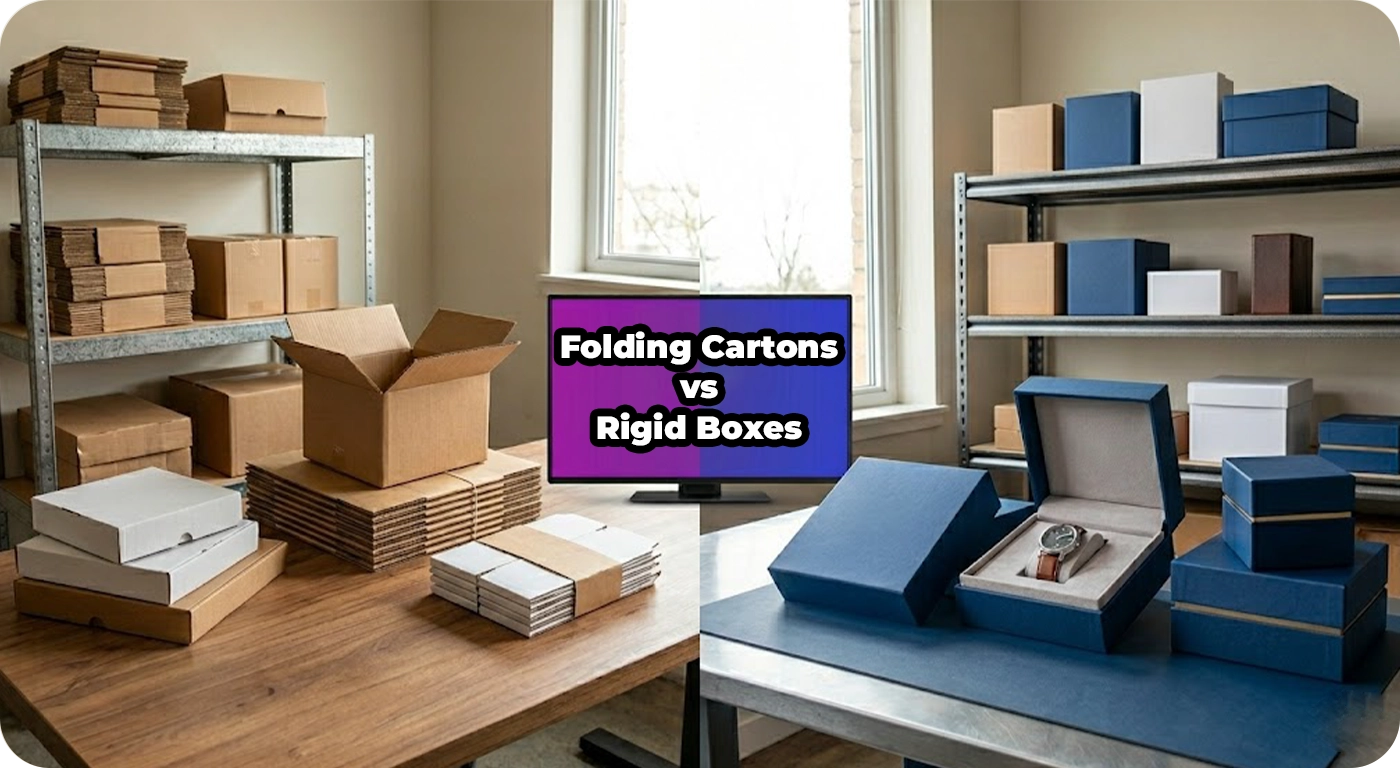
Every brand comparing custom rigid boxes to folding cartons is really weighing the same underlying question: how much does the unboxing experience matter to this specific product?
There's no universally correct answer, but there is a clear framework for making the decision deliberately rather than defaulting to whichever format a supplier happens to push.
Structural Durability
Rigid boxes are built from a solid chipboard core, typically 1.5mm to 3mm, that holds its shape independent of any fold lines. Folding cartons, by contrast, rely on scored fold lines and interlocking tabs for structure, which means their rigidity comes from assembly geometry rather than raw material thickness.
In practical terms, a rigid box withstands compression, repeated handling, and reuse far better than a folding carton of comparable size. A folding carton that gets opened and closed a dozen times will show wear at the fold lines; a rigid box generally won't.
Cost Per Unit
This is where folding cartons have a clear structural advantage. Because folding cartons ship flat and are assembled at the point of packing, they're cheaper to produce, store, and ship than pre-assembled rigid boxes, which take up their full dimensional volume from the moment they leave the factory.
For high-volume e-commerce operations shipping thousands of units monthly, that cost difference compounds quickly. We generally recommend that brands request quotes at their actual expected order volume, since per-unit cost differences between rigid and folding formats narrow somewhat at higher volumes but never fully close.
Brand Perception and Unboxing Experience
This is where rigid boxes earn their premium. The weight of a rigid box in hand, the resistance of a well-fitted lid, and the absence of visible fold lines all signal quality before a customer has evaluated the product itself.
This isn't a marginal effect: unboxing experience research consistently shows that packaging quality shapes a customer's initial quality perception of the product inside it, sometimes more than the product specifications alone.
Folding cartons can be dressed up considerably, with soft-touch laminate, spot foil, and high-quality offset printing, but they can't fully replicate the structural presence of rigid construction.
Shipping and Storage Efficiency
Folding cartons ship flat, meaning a pallet of unassembled cartons takes up a fraction of the space that the same quantity of assembled rigid boxes would require.
For brands managing warehouse space or shipping packaging materials internationally before final assembly, this is a genuinely significant operational factor, not just a cost line item.
Rigid boxes, particularly non-collapsible two-piece styles, need to be stored and shipped in their final assembled dimensions, which raises freight costs and warehouse footprint requirements considerably compared to flat-packed folding cartons.
Turnaround and Production Complexity
Folding carton production is generally faster and more forgiving of design changes late in the process, since the tooling and printing process is more standardized across the industry.
Rigid box production involves more manual assembly steps, wrapping chipboard cores by hand or with specialized equipment, which extends typical turnaround and makes last-minute design changes more costly to accommodate.
If your business needs frequent packaging updates, seasonal designs, or fast reorder cycles, that production complexity is worth weighing against the brand benefits rigid construction offers.
Environmental Considerations for Each Format
Both formats can be produced with meaningful sustainability credentials, but the considerations differ. Folding cartons, being lighter and often made from recycled or FSC-certified board, generally carry a lower shipping-related carbon footprint per unit due to their flat-pack efficiency.
Rigid boxes, when produced with SFI-certified board stock and soy-based inks, can close much of that gap on the materials side, though their pre-assembled shipping format still carries a heavier freight footprint than flat-packed cartons.
Neither format is categorically the more sustainable choice; the honest answer depends on your specific supply chain, shipping distances, and which certifications matter most to your brand's sustainability commitments.
A Practical Decision Framework
Rather than treating this as an abstract quality-versus-cost trade-off, it helps to ground the decision in your specific product and business model.
If your average order value is high enough that unboxing experience meaningfully influences repeat purchase and word-of-mouth, cosmetics, jewelry, premium spirits, subscription boxes, rigid construction often pays for itself.
If you're shipping high volumes of a lower-margin product where cost-per-unit directly determines profitability, a well-specified folding carton with premium finishes can deliver much of the visual impact at a fraction of the structural cost.
We work with brands across both categories, and the honest answer is that the right choice depends entirely on where your product sits on that spectrum, not on which format sounds more impressive on paper.
Making the Switch, or Testing Both
Brands uncertain which format is right don't have to guess blind. Ordering a small sample run in both formats, at genuine production specifications rather than generic samples, is the most reliable way to evaluate the real difference in hand-feel and unboxing impact for your specific product and branding.
That comparison, made with your actual product in the box rather than an abstract description, tends to make the decision considerably clearer than any specification sheet can.
It's a modest upfront cost that consistently prevents the more expensive mistake of committing to a full production run based on assumptions rather than direct comparison.

 English
 Arabic
 French
 Spanish
 Portuguese
 Deutsch
 Turkish
 Dutch
Dutch
 Italiano
 Russian
 Romaian
 Portuguese (Brazil)