


Aerospace Composite Ducting Market Growth to Reach US$ 1.6 Billion by 2034 with Strong Commercial Aircraft Demand
Market Overview and Growth Outlook
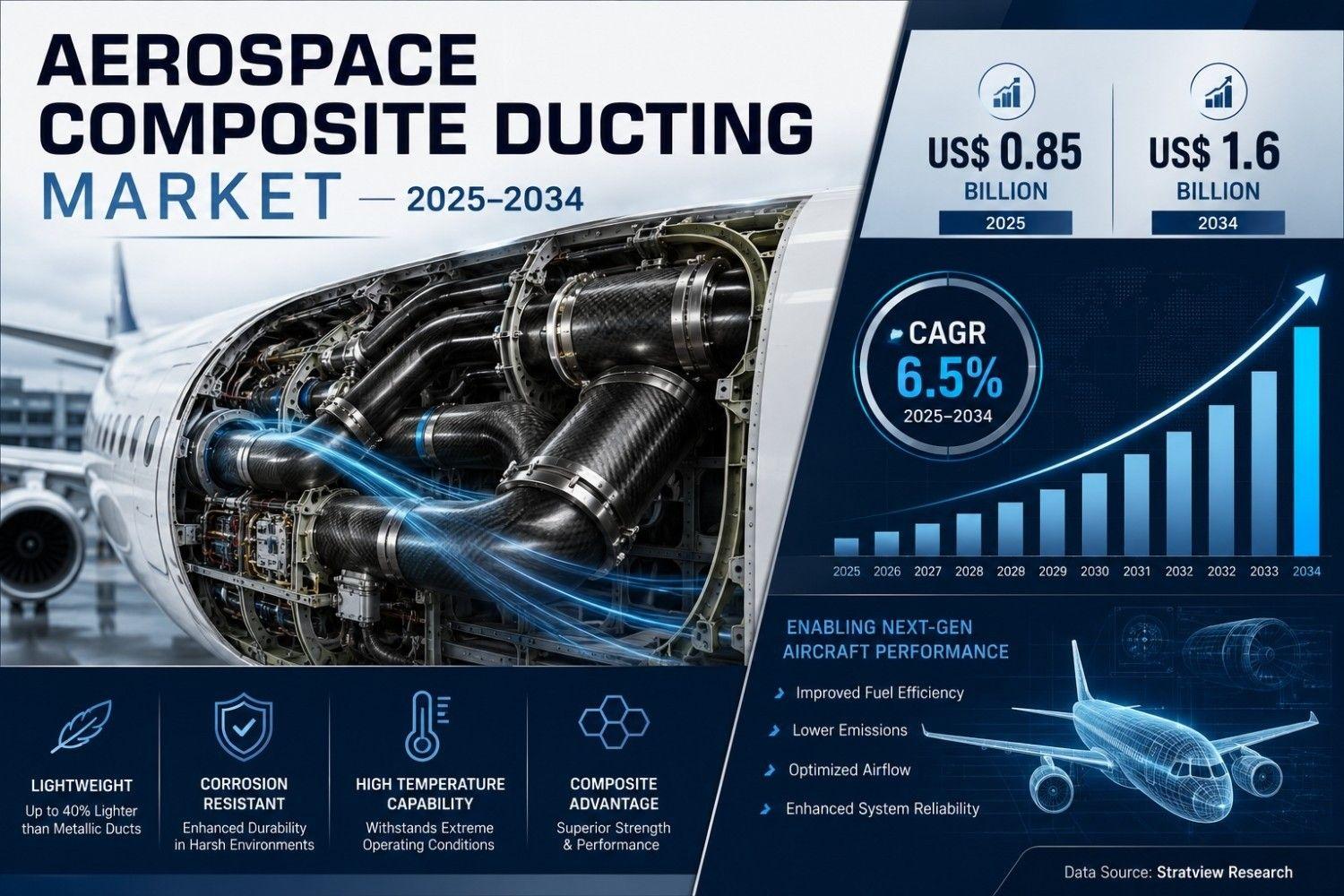
The Aerospace Composite Ducting Market is growing from US$ 0.85 billion in 2025 to a projected US$ 1.6 billion by 2034. The market’s expansion is closely tied to the rising use of lightweight duct assemblies in aircraft and spacecraft for air, gases, fluids, thermal management, and ventilation.
The Aerospace Composite Ducting Market is expected to grow at a CAGR of 6.5% during 2025–2034. Demand is increasing as modern aircraft manufacturers shift toward composite ducting solutions that provide superior strength-to-weight ratio, design flexibility, thermal resistance, corrosion resistance, and lower maintenance requirements than traditional metallic ducting.
Request a free sample report:
https://www.stratviewresearch.com/Request-Sample/aerospace-and-defense-composite-ducting-market#form
The strongest signal in Aerospace Composite Ducting Market growth comes from commercial aircraft. Rising air travel demand, increasing aircraft production rates, strong order backlogs, and fuel-efficient platform adoption are creating sustained demand for composite duct assemblies across modern aircraft programs.
Market Segmentation Analysis
The Aerospace Composite Ducting Market is segmented by Aircraft Type (Commercial Aircraft, Regional Aircraft, General Aviation, Military Aircraft, Helicopter, UAV, and Spacecraft), by Pressure Type (Low-Pressure Ducting and High-Pressure Ducting), by Reinforcement Type (Glass Fiber Composites, Carbon Fiber Composites, and Other Composites), by Matrix Type (Epoxy Composites, Phenolic Composites, Other Thermoset Composites, and Thermoplastic Composites), by Application Type (ECS, APU, Avionic Ventilation, and Other Applications), and by Region (North America [The USA, Canada, and Mexico], Europe [Germany, France, The UK, Russia, and Rest of Europe], Asia-Pacific [Japan, China, India, and Rest of Asia-Pacific], and Rest of the World [Brazil, Argentina, and Others]).
Commercial Aircraft are expected to remain the growth engine, dominant segment, and fastest-growing category. This segment benefits from fleet expansion, narrow-body and wide-body aircraft demand, higher production rates, and the need for improved environmental control systems, thermal efficiency, and reduced maintenance requirements.
Glass Fiber Composites are dominant because they are widely used across aircraft systems and have a proven manufacturing base. Carbon Fiber Composites are expected to register the highest growth, supported by increasing use in next-generation aircraft where enhanced structural efficiency and lightweight performance are required.
Epoxy Composites are likely to dominate the market, while Thermoplastic Composites are expected to post the highest growth trajectory. Low-Pressure Ducting remains dominant, while High-Pressure Ducting is expected to grow the fastest due to rising demand for high-performance thermal and air management solutions.
ECS is projected to remain the dominant and fastest-growing application type. The segment benefits from its broad role in cabin air distribution, ventilation, cooling, temperature regulation, and efficient air management within modern aircraft operations.
Regional Market Insights
North America is expected to remain the largest Aerospace Composite Ducting Market. The region’s demand is supported by strong commercial and defense aviation activity, major aircraft manufacturers, advanced aerospace infrastructure, next-generation aircraft technology investment, and high production rates of modern aircraft platforms.
Asia-Pacific is expected to witness the highest growth in the coming years. The region’s growth is linked to rising passenger traffic, increasing aircraft procurement, aerospace manufacturing capability expansion, airport infrastructure development, indigenous aircraft programs, and the expansion of low-cost airline fleets.
Emerging Trends Shaping the Aerospace Composite Ducting Market
A core market trend is the move toward lightweight composite-based ducting systems that reduce aircraft weight and improve operational performance. This trend supports airline and OEM efforts to improve fuel economy and meet environmental performance expectations.
The market is also shaped by higher adoption of automated manufacturing processes. Resin transfer molding, additive manufacturing, and integrated duct assembly designs are improving efficiency while enabling duct shapes that support complex aircraft system requirements.
High-performance material adoption is becoming more important. Carbon Fiber Composites and Thermoplastic Composites are gaining momentum as aircraft platforms demand more advanced material systems with structural efficiency, thermal resistance, and performance reliability.
Key Growth Drivers of the Market
• Rising global aircraft production is expanding demand for composite ducting because more aircraft platforms require lightweight air and fluid management systems.
• Commercial aircraft fleet expansion is increasing demand for duct assemblies that support fuel efficiency, cabin air distribution, and reduced maintenance requirements.
• The adoption of advanced composite materials is replacing metallic ducting where weight, corrosion resistance, and thermal resistance matter.
• High-pressure ducting demand is rising as advanced engine systems require stronger thermal and air management performance.
• ECS demand is growing because modern aircraft require efficient environmental control, cabin ventilation, cooling, and onboard air distribution.
Competitive Landscape
Top Companies in the Market
AIM Aerospace
Arrowhead Products Corporation
ITT Corporation
Parker-Hannifin Corporation
Senior Aerospace
Stelia Aerospace
Triumph Group
Conclusion and Strategic Outlook
The Aerospace Composite Ducting Market is forecast to reach US$ 1.6 billion by 2034 from US$ 0.85 billion in 2025, growing at a CAGR of 6.5%. Commercial aircraft demand, lightweighting initiatives, composite material adoption, and improved manufacturing technologies remain central to this growth trajectory.
North America is expected to retain market dominance, while Asia-Pacific is expected to grow fastest. The strategic outlook points to a market increasingly shaped by aircraft efficiency, high-performance material selection, and system-level integration across commercial, defense, UAV, and spacecraft applications.
FAQs – Aerospace Composite Ducting Market
What is the projected value of the Aerospace Composite Ducting Market?
The Aerospace Composite Ducting Market is projected to reach US$ 1.6 billion by 2034. It was valued at US$ 0.85 billion in 2025, showing a steady long-term growth path.
What is the CAGR of the Aerospace Composite Ducting Market?
The Aerospace Composite Ducting Market is expected to grow at a CAGR of 6.5% during 2025–2034. This rate reflects demand across aircraft and spacecraft ducting systems.
What is driving Aerospace Composite Ducting Market growth?
Growth is driven by rising aircraft production, fuel-efficient aircraft deliveries, lightweight component demand, and advanced composite material adoption. Commercial aircraft are expected to remain the key demand driver.
Which region has the strongest demand in the Aerospace Composite Ducting Market?
North America is expected to remain the largest Aerospace Composite Ducting Market. Asia-Pacific is expected to witness the highest growth during the forecast period.
What are the main strategic considerations in the Aerospace Composite Ducting Market?
Strategic considerations include material performance, ducting pressure requirements, aircraft platform mix, and production efficiency. The Aerospace Composite Ducting Market remains attractive where lightweighting and lifecycle cost reduction are priorities.

 English
 Arabic
 French
 Spanish
 Portuguese
 Deutsch
 Turkish
 Dutch
Dutch
 Italiano
 Romaian
 Portuguese (Brazil)
 Greek
Greek