

Ion Implanter Market Growth Outlook Points to USD 4.9 Billion Opportunity by 2032
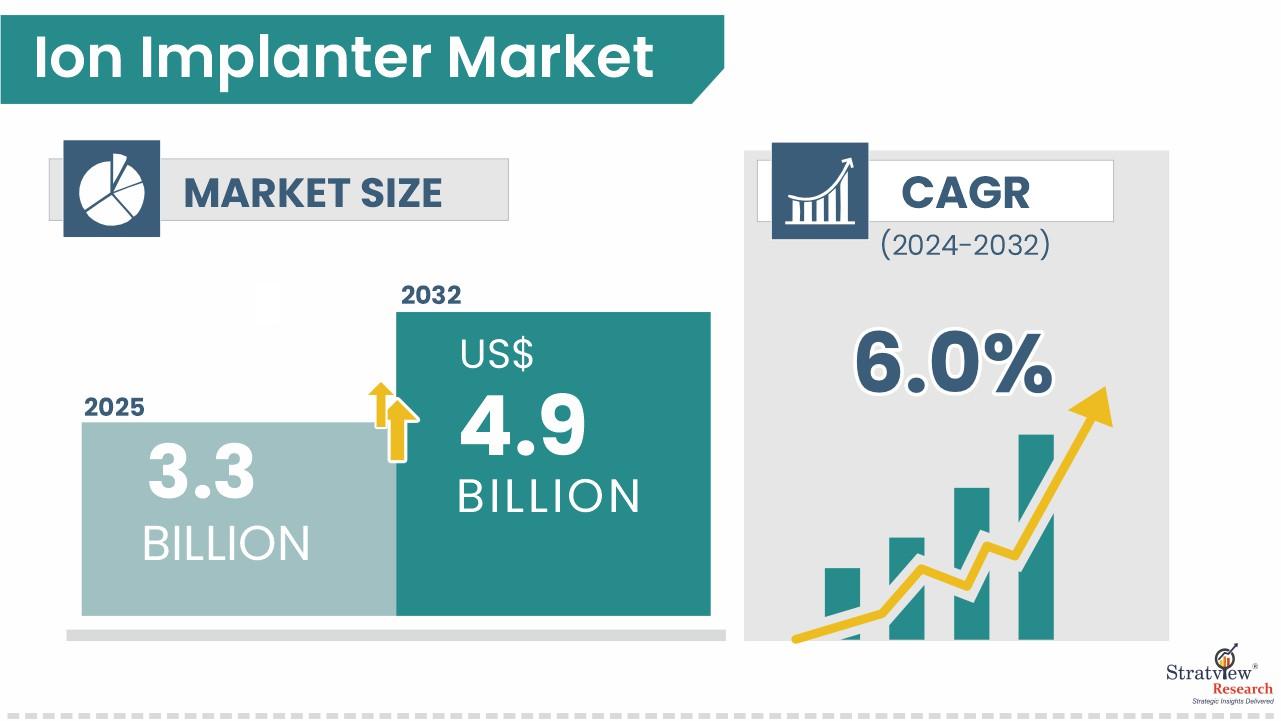
The Ion Implanter Market was estimated at USD 3.3 billion in 2025 and is likely to reach USD 4.9 billion in 2032. The market is expected to advance at a CAGR of 6.0% over the 2024–2032 forecast period. The Ion Implanter Market is expected to grow at a CAGR of 6.0% during 2024–2032. Increasing digital connectivity and demand for advanced semiconductor components are central to this growth trajectory.
The projected Ion Implanter Market growth is grounded in the equipment’s role within modern electronics manufacturing. Ion implanters modify semiconductor materials through controlled ion placement, enabling uniform distribution, process repeatability, reduced material waste, and enhanced material performance. Their compatibility with complex geometries and high-production environments is important as manufacturers develop smaller, more powerful, energy-efficient, and cost-effective electronic devices. These capabilities connect ion implantation demand with consumer electronics, power devices, memory, solar-cell manufacturing, LEDs, and specialized material-modification processes.
An ion implanter introduces ions into a material to change its physical, chemical, or electrical properties. The equipment architecture includes an ion source, mass analyzer, ion beam accelerator, and end station. The main equipment types identified are high-current, medium-current, and high-energy implanters.
Ion implantation supports silicon-wafer doping in semiconductor manufacturing. The technology is also used to produce thin films, improve wear resistance in metals, modify biological materials, raise solar-cell efficiency, and alter surfaces in glasses and research materials. Its ability to provide precise treatment across different materials underpins its relevance within the stated market scope.
Request a free sample report:
https://www.stratviewresearch.com/Request-Sample/ion-implanter-market#form
Market Segmentation Analysis
The Application Type segmentation consists of General Mature, Memory, Logic, Image Sensor, and Power. Power is expected to be the demand generator and remains the dominant application. Memory is identified as the fastest-growing application during the coming years.
Power’s leading position reflects the role of precisely doped silicon and increasingly silicon carbide wafers in high-voltage and high-current systems. Battery-powered systems rely on these power devices, while silicon carbide devices require more complex and multiple implantation steps than conventional silicon. Demand is connected to EVs, fast-charging infrastructure, renewable-energy systems, and energy storage.
Memory growth is supported by new wafer starts and technology upgrades in DRAM and NAND. These developments are intended to meet rising bit demand from AI, data centers, and cloud computing. The resulting production requirements increase the use of advanced ion implantation tools within memory-manufacturing operations.
The Machine Type segmentation includes Low-Medium-Current Implanter, High-Current Implanter, and High-Energy Implanter. High-Current Implanter is anticipated to contribute the largest market share and remain the dominant machine type over the forecast period.
High-current implanters are primarily used for doping in semiconductor manufacturing. They also support the production of solar cells, LEDs, and other electronic components. Their ability to process larger wafer sizes and provide high throughput makes them appropriate for mass production, where efficiency, cost savings, and faster production cycles are important.
Their continued development is linked to more complex and miniaturized electronic components. Innovations in beamline design and process control improve the precision of dopant distribution and concentration, enabling high-current systems to serve evolving device designs while sustaining manufacturing productivity.
The regional segmentation covers North America, Europe, Asia-Pacific, and the Rest of the World. North America includes The USA and Rest of North America. Europe includes Germany, the Netherlands, The UK, and the Rest of Europe. Asia-Pacific includes Japan, South Korea, Taiwan, China, and Rest of Asia-Pacific. The Rest of the World includes the Middle East and Others.
Regional Market Insights
Asia-Pacific is expected to maintain its dominance throughout the forecast period. Several rapidly developing economies, including China, India, and South Korea, are increasing investment in semiconductor and electronics sectors. Because both industries use ion implantation technology, investment across these manufacturing ecosystems supports regional equipment demand.
The region has skilled labor and advanced manufacturing facilities and continues to advance semiconductor production. These capabilities attract local and international companies, expanding the industrial base associated with ion implantation technology.
Government measures, including tax incentives, grants, and policies supporting ease of doing business, encourage investment in advanced technologies. Asia-Pacific also benefits from strong supply-chain networks that enable efficient production and distribution of ion implanters. Together, these conditions strengthen the region’s leadership in the regional analysis.
Emerging Trends Shaping the Ion Implanter Market
The demand for customized semiconductor materials is becoming increasingly important. Semiconductor manufacturers are working to produce devices that are more powerful, energy-efficient, and cost-effective. Ion implantation supports this direction by enabling controlled changes to the physical, chemical, and electrical properties of semiconductor materials.
Silicon carbide processing is strengthening demand within power applications. Compared with conventional silicon, silicon carbide devices require more complex and repeated implantation steps. This increases the amount and sophistication of ion implantation required for devices serving EVs, charging infrastructure, renewable-energy systems, and energy-storage applications.
AI, data centers, and cloud computing are influencing implantation-equipment requirements through the memory ecosystem. Rising bit demand is supporting new wafer starts and technology upgrades across DRAM and NAND manufacturing, increasing the need for advanced ion implantation tools.
Another stated direction is the continued evolution of high-current implanters. Beamline and process-control innovations are helping these machines manage more complex and miniaturized components through precise dopant control, while larger-wafer capability and high throughput maintain their suitability for mass-production operations.
Key Growth Drivers of the Market
- Digital connectivity requirements: Increasing digital connectivity expands the need for semiconductor-enabled electronics, raising demand for fabrication technologies such as ion implantation.
- Consumer-device production: Growing demand for smartphones, tablets, laptops, and smart televisions supports higher semiconductor-component requirements across the electronics ecosystem.
- Semiconductor efficiency objectives: Manufacturers need increasingly advanced and efficient components, creating demand for tools that deliver precise ion placement, uniform distribution, and repeatability.
- Power-device manufacturing: Silicon and silicon carbide power devices support high-voltage and high-current applications, while silicon carbide requires more complex implantation processes.
- Expanding memory requirements: Rising bit demand from AI, data centers, and cloud computing supports DRAM and NAND wafer starts, technology upgrades, and advanced implantation-tool demand.
Competitive Landscape
More than 100 companies operate in the Ion Implanter Market, resulting in a highly fragmented competitive structure. Major participants compete on factors that include price, service offerings, and regional presence. The strategic position of each supplier is therefore influenced not only by its equipment portfolio but also by its ability to support customers across relevant semiconductor-producing regions.
Top Companies in the Market
- Applied Materials Inc
- Axcelis Technologies
- Nissin Ion Equipment Co. Ltd
- Sumitomo Heavy Industries Ion Technology Co. Ltd.
- Advanced Ion Beam Technology, Inc.
- Intevac Inc.
- ULVAC
- Electronics Equipment Group Co., Ltd.
Conclusion and Strategic Outlook
The Ion Implanter Market is projected to grow at 6.0% during 2024–2032 and reach USD 4.9 billion by 2032. The growth analysis is supported by digital connectivity, consumer-electronics demand, advanced semiconductor production, customized material requirements, power-device processing, and memory-manufacturing expansion.
Power is expected to remain the dominant application, with Memory recording the fastest application growth. High-Current Implanter is expected to remain the leading machine type, while Asia-Pacific continues to hold the dominant regional position. The long-term industry outlook is therefore tied to semiconductor production scale, device complexity, material-performance requirements, and the ability of implantation systems to combine precision with high throughput.
FAQs – Ion Implanter Market
1. What is the current value and future forecast for the Ion Implanter Market?
The Ion Implanter Market was estimated at USD 3.3 billion in 2025. The market is likely to reach USD 4.9 billion by 2032.
2. How rapidly is the Ion Implanter Market expected to grow?
The Ion Implanter Market is expected to record a CAGR of 6.0% during 2024–2032. The rate reflects continuing demand from semiconductor manufacturing and related electronics applications.
3. What are the principal growth drivers for ion implantation equipment?
The main drivers are digital connectivity, consumer electronics, advanced semiconductor-component demand, customized semiconductor materials, power-device manufacturing, and memory-production upgrades. These developments increase the need for accurate and efficient ion implantation.
4. Where is Ion Implanter Market demand strongest?
Asia-Pacific is expected to continue dominating the Ion Implanter Market during the forecast period. Investment in semiconductors and electronics, manufacturing capabilities, skilled labor, government support, and supply chains sustain its position.
5. What challenges affect the Ion Implanter Market investment outlook?
The market is highly fragmented and includes more than 100 participants. Companies compete through price, service offerings, and regional presence, making competitive positioning and customer-support coverage important investment considerations.

 Arabic
 French
 Spanish
 Portuguese
 Deutsch
 Turkish
 Dutch
Dutch
 Italiano
 Russian
 Romaian
 Portuguese (Brazil)
 Greek
Greek