


Cured-in-Place Pipe (CIPP) Market Forecast Signals USD 3.8 Billion Opportunity by 2032
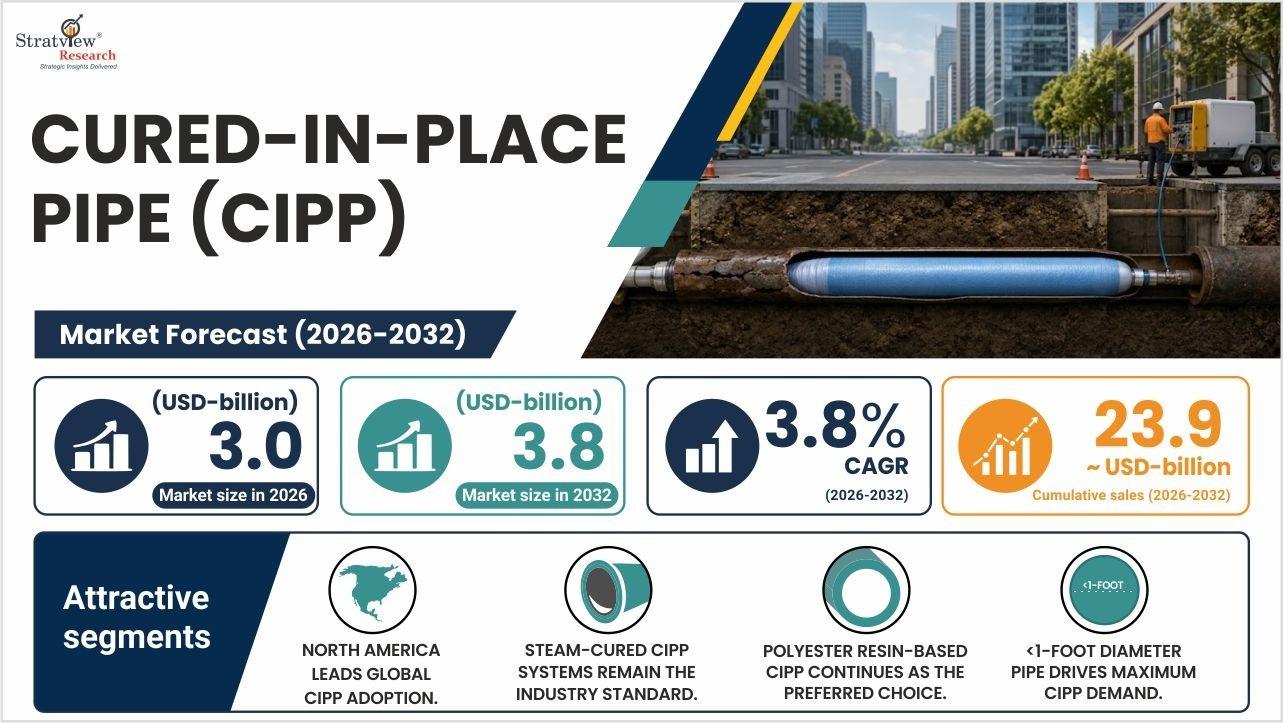
Annual demand in the Cured-in-Place Pipe (CIPP) Market reached USD 2.9 billion in 2025 and is projected to increase to USD 3.0 billion in 2026. The market forecast indicates annual sales of USD 3.8 billion by 2032. The Cured-in-Place Pipe (CIPP) Market is expected to grow at a CAGR of 3.8% during 2026–2032. The industry outlook is supported by pipeline deterioration, infrastructure renewal, and demand for rehabilitation methods that limit excavation and service interruptions.
The projected Cured-in-Place Pipe (CIPP) Market size reflects a broader shift toward restoring existing underground assets rather than relying solely on open-cut replacement. Conventional projects can require excavation, road closures, utility disruption, and extensive surface restoration. CIPP addresses these constraints by creating a seamless pipe within the existing pipeline. This reduces construction complexity while helping infrastructure owners shorten rehabilitation schedules, protect surrounding surfaces, and maintain greater continuity across municipal and utility services.
Request a free sample report:
https://www.stratviewresearch.com/Request-Sample/Cured-in-Place-Pipe-CIPP-Market#form
Market Segmentation Analysis
By Diameter Type, the CIPP market is segmented into <1 foot, 1–2.5 feet, 2.5–5.0 feet, and >5.0 feet. The <1-foot diameter pipe category is forecast to remain the largest and fastest-growing segment. Its leadership is linked to the substantial installed base of small-diameter sewer and potable water pipelines. The widespread use of standard pipe sizes within this category creates a recurring requirement for rehabilitation, supporting both current demand and its forecast growth trajectory.
By Resin Type, the market is categorized into polyester, vinyl ester, and epoxy resin-based CIPP. Polyester resin-based CIPP is expected to maintain its dominant position, whereas epoxy resin-based CIPP is projected to grow fastest. Polyester resin benefits from cost efficiency, chemical resistance, and favorable mechanical performance in sewer and stormwater applications. Epoxy resin supports lower VOC emissions, contains no hazardous air pollutants, and addresses potable water applications where NSF/ANSI 61 compliance is required.
By Fabric Type, the market is segmented into polyester fabric-based CIPP, glass fabric-based CIPP, and other fabrics-based CIPP. Polyester fabric-based CIPP is likely to remain the preferred choice, while glass fabric-based CIPP is expected to record the fastest growth. Polyester fabric combines tensile strength performance, efficient resin absorption, and cost advantages. Glass fabric is gaining relevance in UV-cured installations because it supports cleaner curing and avoids harmful by-products typically associated with steam- or water-cured felt liners.
By Curing Type, the market includes hot water-cured CIPP, steam-cured CIPP, and UV-cured CIPP methods. Steam-cured CIPP is expected to continue leading the category, supported by faster heat transfer, reduced curing time, simpler setup, and stronger finished liners. UV-cured CIPP is anticipated to register the highest growth because it offers faster installation, no refrigeration requirements, lower emissions, higher liner strength, and reduced sensitivity to changing temperatures during the curing process.
PP-coated CIPP is likely to remain the most dominant coating type in the market. The study also examines Weaving Type and Region as part of its complete segmentation structure. These categories allow the market analysis to capture how pipe dimensions, resin chemistry, liner construction, coating selection, and curing technologies influence adoption. The resulting industry intelligence highlights a market supported by mature rehabilitation configurations while operationally efficient and environmentally aligned alternatives gain greater acceptance.
Regional Market Insights
North America is projected to remain the largest market throughout the forecast period. Regional leadership is driven by the USA, which has an extensive network of aging pipelines requiring rehabilitation. Much of this infrastructure was constructed after World War II, creating a large installed base with continuing renewal requirements. This structural condition supports demand for CIPP across municipal water, wastewater, sewer, and stormwater networks where asset owners seek rehabilitation without the extensive disruption associated with conventional replacement.
Asia-Pacific is expected to record the fastest growth. CIPP penetration remains relatively low across the region, but the adoption of trenchless technologies is increasing. Rapid urbanization, infrastructure development, and growing awareness of efficient rehabilitation methods are supporting the regional market outlook. As underground utility networks expand and existing systems require renewal, infrastructure owners are increasingly considering technologies that can restore pipeline performance while minimizing excavation in densely populated and operationally sensitive environments.
Emerging Trends Shaping the Cured-in-Place Pipe (CIPP) Market
The shift toward UV-cured CIPP represents a notable change in the technology mix. UV curing provides improved process control, faster installation, lower environmental impact, and reduced temperature sensitivity compared with traditional curing methods. It is particularly relevant for large-diameter sewer and wastewater pipelines. Glass fabric adoption is advancing alongside this trend because the material is well suited to UV applications and supports cleaner curing processes. These connected developments are expanding the technology choices available to contractors and municipalities.
Sustainable liner materials and digital pipeline inspection are becoming integral to the market’s future direction. Sustainable liners address demand for lower-impact rehabilitation, while digital inspection helps infrastructure owners make better asset-management decisions. These developments create a more integrated rehabilitation approach combining pipeline-condition information, material selection, and controlled installation. The competitive landscape is therefore evolving around the ability to support effective rehabilitation outcomes through appropriate liner systems, curing methods, and data-informed planning rather than through excavation-intensive replacement alone.
Key Growth Drivers of the Market
- Deteriorating water infrastructure: Aging systems increase pipeline failures and rehabilitation requirements, creating sustained demand for CIPP solutions across utility networks.
- Infrastructure-renewal investment: Municipalities and asset owners are prioritizing existing pipeline networks, expanding the addressable opportunity for trenchless rehabilitation providers.
- Lower construction disruption: CIPP reduces excavation, road closures, and utility interruptions, making rehabilitation more practical in active urban and public environments.
- Operational and lifecycle benefits: Faster installation and extended pipeline service life improve the long-term value of CIPP for infrastructure owners and utility operators.
- Growing UV-cured adoption: Faster curing, improved process control, lower emissions, and stronger liner performance are expanding the role of UV-based systems.
Competitive Landscape
Top Companies in the Market
Aegion Corporation (now known as Azuria Water Solutions)
PURIS Corporation
Per Aarsleff A/S
Waterline Renewable Technologies, Inc.
SAK Construction
SAERTEX Multicom® GmbH
RELINE UV Group
Vortex Companies
Conclusion and Strategic Outlook
The Cured-in-Place Pipe (CIPP) Market is forecast to advance from USD 3.0 billion in 2026 to USD 3.8 billion in 2032 at a CAGR of 3.8%. Demand is anchored in aging pipeline systems, infrastructure-renewal priorities, and the operational advantages of trenchless rehabilitation. Segment growth will also reflect increasing interest in epoxy resins, glass fabrics, and UV-cured systems. The strategic outlook remains tied to solutions that restore pipeline performance while reducing excavation, environmental impact, construction time, and service disruption.
FAQs – Cured-in-Place Pipe (CIPP) Market
1. How large will the Cured-in-Place Pipe (CIPP) Market become?
The Cured-in-Place Pipe (CIPP) Market is expected to increase from USD 3.0 billion in 2026 to USD 3.8 billion in 2032. The market generated USD 2.9 billion in annual demand during 2025.
2. At what CAGR is the market forecast to grow?
The Cured-in-Place Pipe (CIPP) Market is forecast to grow at a CAGR of 3.8% from 2026 to 2032. This growth is supported by continuing investment in pipeline rehabilitation and infrastructure renewal.
3. Why is demand for CIPP technology increasing?
Demand is increasing because aging water, wastewater, and industrial pipelines require cost-effective rehabilitation. CIPP reduces excavation, project duration, surface restoration, traffic disruption, and interruptions to essential services.
4. What is the regional outlook for the market?
North America is expected to remain the largest market because of its extensive aging pipeline network. Asia-Pacific is likely to grow fastest as urbanization, infrastructure development, trenchless technology adoption, and awareness increase.
5. What could influence future investment in the market?
Limited awareness in developing regions may restrict adoption despite increasing rehabilitation needs. Investment opportunities are associated with UV-cured CIPP, sustainable liners, digital inspection, and solutions offering improved installation efficiency and environmental performance.

 English
 Arabic
 French
 Spanish
 Portuguese
 Deutsch
 Turkish
 Dutch
Dutch
 Russian
 Romaian
 Portuguese (Brazil)
 Greek
Greek