


How RCM Systems Use Predictive Analytics for Denial Prevention

Predictive RCM architecture analyzes millions of data points to identify payer behavior. It also uses historical data to detect denial patterns. The system assigns a score to each claim before submission. It flags high-risk claims, enabling the billing team to correct errors in immediate review. Predictive analytics identifies claim issues, such as incomplete patient information, coding errors, and payer-specific compliance issues.
The advanced predictive systems employ a modular system approach to process billing data in an efficient manner. It enables Revenue Cycle Management (RCM) professionals to manage billing information in a structured, stepwise manner, improving overall accuracy.
The proactive RCM intelligence system combines Electronic Health Record (EHR) and billing codes in one data set. The Machine Learning (ML) system continuously learns from the data and improves prediction accuracy over time.
What are the Key Uses of Predictive Analytics in Denial Prevention?
Predictive analytics RCM tools help healthcare providers in catching billing mistakes in real-time. To ensure claim accuracy, AI checks each claim using front-end patient and payer information. It improves the first-pass payment approval rate. Here are the key functions of the integrated healthcare data systems:
-
Detects insurance coverage issues.
-
Identifies and flags insurance eligibility issues.
-
Finds coding anomalies to prevent billing errors.
-
It carefully examines key details such as correct modifier usage and conflicting claim entries.
-
Changes the overall denial management workflow in the revenue cycle from reactive denial correction to proactive risk prevention.
-
Enhances overall billing precision and improves financial performance in healthcare billing.
Critical Data Signals for Claim Prediction
Predictive models track data signals to understand the chances of approval or denial of a claim. The claim-risk forecasting tools continuously monitor the following signals to check claim health:
-
The system matches Current Procedural Terminology (CPT) and the International Classification of Diseases (ICD) with the claim. It ensures the service supports the medical condition.
-
Confirms patient’s insurance coverage, benefit limits, and co-pay requirements.
-
Maintains a comprehensive record of historical payer rule changes.
-
Analyzes a practice’s billing and coding patterns to detect behaviors that may trigger audits. It minimizes the chances of external audits.
The American Hospital Association (AHA) research highlights that AI-driven revenue cycle management reduces claim denials. Delivers 22% fewer denials for prior authorization and 18% for non-covered services. Such outcomes become achievable because of finding coding mistakes, eligibility gaps, and payer rejection patterns early.
Types of Predictive Analytics Models in RCM Systems
Proactive RCM platforms use different types of predictive models, and each serves a specific role. Some models check mistakes at the initial stage of the billing cycle, and some predict the chances of claim denials. While some analyze the past denial patterns to prevent mistakes in the future. These work together to ensure timely and complete reimbursements. Let us discuss three proactive RCM models along with their functions:
Pre-Submission Prediction Model
The pre-submission risk model analyzes claims before claim submission to catch billing errors. Consider it a final checkpoint of a claim that strictly checks the alignment of clinical documentation with financial data.
With this model, the machine learning algorithms perform logic-based scrutiny while comparing the claim with historical records. The Healthcare Financial Management Association (HFMA) study tells that pre-submission models catch 12% of surgical claim errors.
Real-Time Claim Scoring Model
The real-time claim scoring models assign a value to each claim when it enters the system. It helps professional billing teams to manage their workload and prioritize claims on the basis of denial risks.
Predictive RCM systems also evaluate payer behavior to estimate the chance of audits for specific procedures. Similarly, they confirm a physician is in-network under the patient’s insurance plan.
The predictive reimbursement analysis also estimates claim adjudication timeline while verifying accuracy and payer compliance. It also calculates the patient’s expected out-of-pocket cost.
Post Denial Clustering Model
The post-denial clustering analytics find common patterns in denied claims. They make a group of similar denial reasons and highlight repeated mistakes, payer-specific issues, and frequent coding errors. It helps RCM professionals to understand the main causes of denials and fix issues across the system.
Different models of RCM foresight systems help billing teams to identify issues and correct them at the right time. It saves healthcare organizations from financial losses. These turn reactive billing corrections into a structured, data-driven revenue cycle that enhances overall cash flow stability.
Financial Impact of Denial Probability Tools in RCM
Claim rejections lead to extra operational costs. They increase administrative work, require additional staff for error correction, and add workload for managing payer responses. Similarly, claim resubmission requires time, effort, and work to maintain proper documentation.
On average, each denial rework costs $25-$117. Moreover, the longer a claim stays unresolved, the harder it becomes to recover the payment. HFMA studies indicate that the chances of successful recovery decrease by up to 12% every 30 days.
Denial probability tools help healthcare organizations save a significant amount while minimizing rework and appeals. The claim-risk forecasting AI tools enable the authorities of a healthcare organization to understand the return on investment. They can analyze the amount they saved through administrative work and the improvement in the claim acceptance rate.
How Does Healthcare Analytics Improve Financial Performance?
Predictive analytics helps healthcare teams to focus on claims that have a higher chance of successful payment recovery. This strategy helps in increasing net revenue. To ensure smooth synchronization, the system checks the following five key components to ensure flawless recovery:
-
The expected reimbursement amount as per the contract with the payer for a specific service code.
-
Estimates the amount and time that the payment recovery process requires.
-
Checks historical response times for a specific clinical area.
-
Determine the difference between the expected payment on payer contracts and the actual amount healthcare organizations receive from payers.
-
Assigns a claim liquidity score that shows the potential of a claim to convert into a collected payment quickly.
Overall, RCM analytics help healthcare organizations strengthen their revenue cycle performance and generate more profits. It minimizes financial uncertainty and enhances revenue predictability.
How Smart Claim Validation Processes Reduce Days in A/R?
Days in Accounts Receivable (A/R) for healthcare organizations reflect the financial waiting that can affect operational stability. The smart validation processes reduce this time while improving first -pass claim accuracy.
Claim accuracy and real-time eligibility checks speed up billing processes while ensuring faster charge entry. Such processes also reduce A/R days and minimize claim rejections.
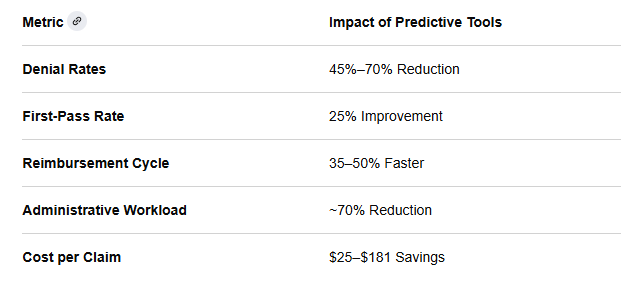
Advanced predictive modeling tools in healthcare improve claim accuracy. At the same time, it allows healthcare organizations to make effective use of their resources and improve operational performance.
AI predictive tools reduce the time between claim submission and final payment. These tools help healthcare organizations improve first-pass claim rates by about 25%. They also reduce denial rates by up to 70%. Moreover, they speed up reimbursement cycles by as much as 50%.
Limitations of Predictive Analytics in Healthcare Billing
Revenue cycle analytics face integration challenges such as disconnected healthcare systems, inconsistent data formats, and workflow incompatibility. Maintaining data quality is one of the key limitations of risk prediction models. Irregularities occur because healthcare organizations store data across different platforms using different formats and coding systems. The gaps, such as missing documentation, inaccurate records, and incomplete patient information, reduce the reliability of predictive insights. Regular medical billing audit services help identify these issues early, strengthen compliance, and improve the quality of data used for predictive analytics.
How Does Data Fragmentation Restrict Claim Denial Prediction?
Predictive models require smooth data linking. The software programs trained on incomplete training sets often fail to meet different adjudication standards. Similarly, delays in system updates can result in incorrect patient eligibility results.
The Experian Health State of Claims Survey reports that 38% of providers experience claim denials. These denials occur due to inaccurate or incomplete data intake.
Intelligent claim management adapts to payer-changing rules and updates processes in real time. So the past data becomes less useful to make accurate predictions. Besides, there are chances that the machine learning models repeat past coding mistakes due to bias in training datasets. Weak connections across platforms disrupt communication with payers and slow down claim resubmission processes. The predictive modeling systems also face challenges in interpreting non-standard clinical notes.
Predictive claim scoring models need continuous updates to provide consistent and reliable performance. Missing retraining of denial prevention tools when insurance companies update their policies increases denial patterns.
Likewise, AI in RCM can repeat mistakes if trained on flawed data. At the same time, it increases the compliance risks for healthcare organizations.
Future of Predictive Analytics in Healthcare Revenue Cycle
The future of predictive analytics in Revenue Cycle Management (RCM) is shifting towards proactive denial management. Future systems aim to prevent denials while automating documentation and coding. Healthcare organizations adopting advanced AI-driven workflows, including providers offering California medical billing services, are increasingly using predictive analytics to improve claim accuracy, accelerate reimbursements, and stay compliant with evolving payer requirements.
Generative AI in healthcare billing reduces the need for manual work to fix claim denials. In the near future, the AI models may prepare documentation, increasing the chances of approval.
The interaction of billing teams with models will become simpler, allowing them to access insights in a clear way. They can give commands in a natural language.
With the help of agentic AI workflows, healthcare organizations are targeting a zero-denial environment. The predictive models ensure accurate claim submission. However, achieving this milestone is highly challenging for healthcare organizations. But very high clean claim rates are the new standard of the industry.
How Outsourcing Enhances Predictive Analytics in Revenue Cycle Management
Outsourcing Revenue Cycle Management (RCM) helps healthcare organizations improve billing pattern analysis while using more advanced tools. The professionals focus on insights to prevent claim errors.
Outsourcing partners offer immediate access to massive data sets and specialized AI infrastructure. In this way, healthcare providers get access to powerful AI tools without making a large investment. It helps healthcare organizations to lower operational costs and get more accurate predictions.
Besides, outsourcing is the smartest decision for healthcare organizations to shift the administrative workload of denial management to billing professionals.
Outsourced predictive analytics services help in improving overall revenue cycle performance. They serve multiple clients and collect data from large billing networks. They study payer behavior, which helps them recognize and adapt to new trends faster.
As a result, the professional billing services ensure correction before claim submission. As a result, the denial rate decreases while improving first-pass payments. They help healthcare organizations to improve overall revenue integrity.
Conclusion
Claims prediction in healthcare revenue cycle management is helping healthcare organizations to develop financially stable billing operations. The predictive AI models help in reducing claims errors and achieving more consistent reimbursement performance. AI in revenue cycle management enhances coordination between clinical records and payer rules. It minimizes the chances of errors and claim denials. It helps billing professionals to prepare claims in a way that meets payer expectations.
Partner with Physicians Revenue Group, Inc. to improve the revenue cycle and reduce overall financial performance. Our experts integrate advanced RCM analytics into your workflow. Helping you to reduce A/R days and improve the first-pass payment rate.
Frequently Asked Questions (FAQs)
1. What is Predictive Analytics in Healthcare RCM?
Healthcare business intelligence uses data and previous billing patterns to predict future outcomes of claims. It helps billing professionals to identify claims that have a higher chance of denials. Enabling the billing team to make corrections before submission.
2. How is AI Claim Validation Different from Traditional Claim Scrubbing?
Traditional scrubbers only catch rule-based static rule violations. However, automated claim validation models forecast denial risks while analyzing payer behavior and historical billing patterns. It also checks real-time clinical and billing data.
3. How Much Does a Single Claim Denial Cost a Practice?
A single denial claim increases administrative work that includes correction, communicating with payers, and claim resubmission. It increases labor costs and delays reimbursement, which disrupts overall cash flow. Considering these scenarios, a single denied claim costs a practice about $25 to $117.
4. How Does the System Stay Updated with Changing Insurance Rules?
Denial management automation software automatically updates with changing insurance rules and continuously learns from new payer data. The machine learning models actively monitor historical and current claim behavior to detect shifts in payer policies.
5. Why is human oversight still needed in AI billing?
Although AI has changed the way of managing the billing processes, it still has limitations. Some claims need expert review and clinical judgment before submission. Human intervention is essential to maintain compliance and ensure accuracy in sensitive cases. The combination of both creates a balanced billing system.

 Arabic
 French
 Spanish
 Portuguese
 Deutsch
 Turkish
 Dutch
Dutch
 Italiano
 Russian
 Romaian
 Portuguese (Brazil)
 Greek
Greek