Market Overview and Growth Outlook
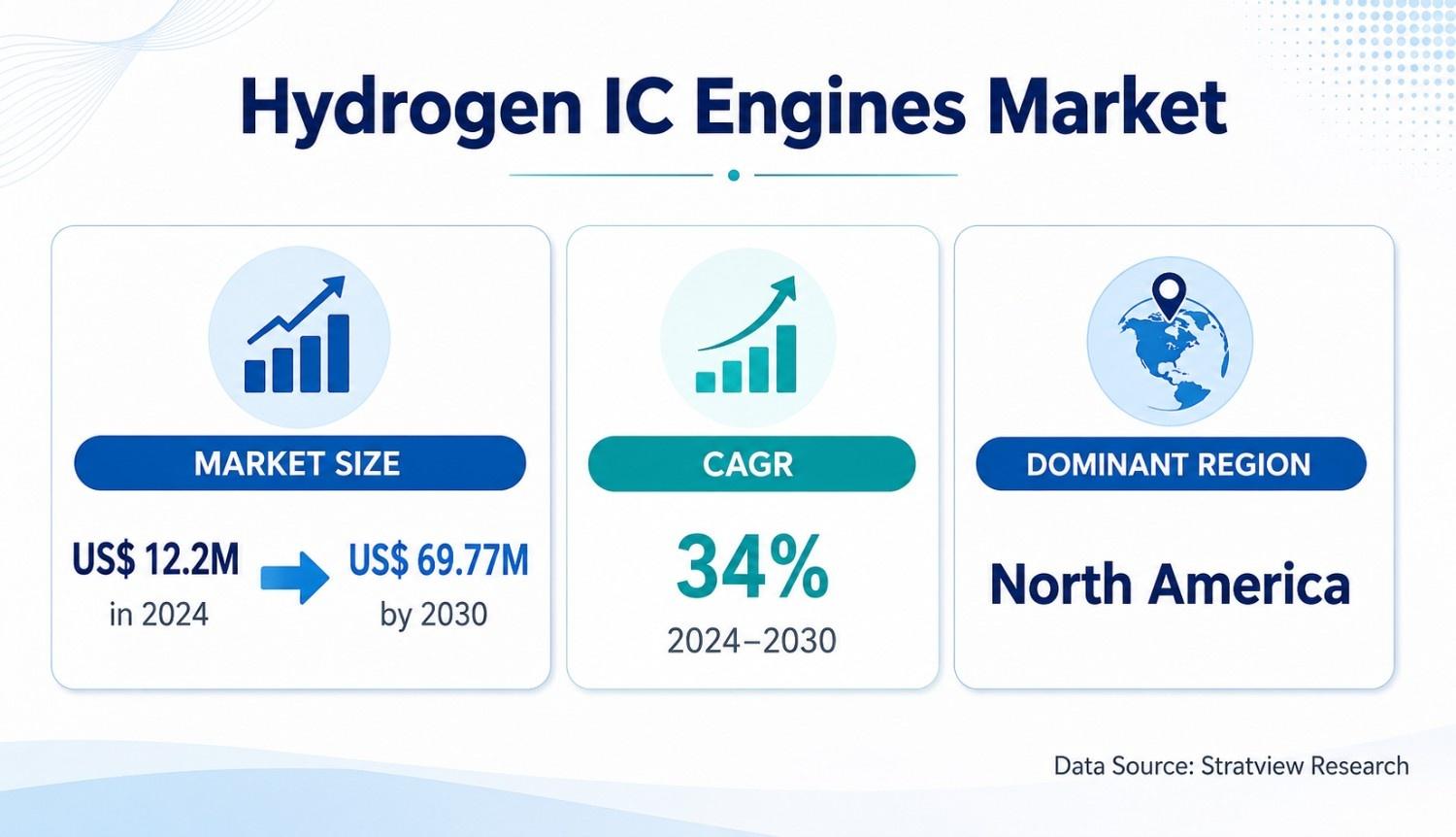
The Hydrogen IC Engines Market was US$ 12.2 million in 2024 and is likely to reach US$ 69.77 million in 2030. The market is expected to grow at a CAGR of 34%, indicating strong expansion for hydrogen-powered combustion systems during the forecast horizon.
“The Hydrogen IC Engines Market is expected to grow at a CAGR of 34% during 2024–2030.” Demand is increasing because hydrogen IC engines offer a low-carbon alternative for transportation and industrial applications while preserving much of the structure of traditional combustion engines.
The competitive landscape is forming around companies with engine, powertrain, industrial, mobility, and energy-system capabilities. For market intelligence teams tracking Hydrogen IC Engines Market share, the listed players show a market where established industrial and mobility companies are shaping hydrogen combustion development.
Request a free sample report:
https://www.stratviewresearch.com/Request-Sample/hydrogen-ic-engines-market#form
The Hydrogen IC Engines Market is gaining momentum due to strict emissions regulations, interest in hydrogen as a clean energy source, and the need for sustainable transport and industrial solutions. These factors connect regulatory pressure with commercialization activity across engine and equipment ecosystems.
Market Segmentation Analysis
The Hydrogen IC Engines Market is segmented by Blending (Mix Blend, and Pure Hydrogen), by State (Gas, and Liquid), by Power rating (Low, Medium, and High), by Application (Transportation and Power Generation), and by Region (North America [The USA, Canada, Mexico, and Rest of North America], Europe [Germany, France, Italy, The UK, and Rest of Europe], Asia-Pacific [China, Japan, India, and Rest of Asia-Pacific], and Rest of the World [South America, Middle East & Africa]).
Mix Blend and Pure Hydrogen are the stated blending segments. Mix Blend type is anticipated to hold the largest share during the forecast years, which places transitional fuel strategies at the center of near-term hydrogen combustion adoption.
Gas and Liquid are the stated state segments. Liquid is expected to register the highest CAGR during the forecast period due to superior energy density and storage efficiency, strengthening its commercial role in demanding applications.
Transportation and Power Generation are the stated application segments. Transportation is anticipated to be the largest segment because of demand for cleaner fuel substitutes for conventional engines in heavy-duty trucks, off-road equipment, and commercial vehicles.
Low, Medium & High are the stated power rating segments. Medium Power rating is leading because of increasing demand for sustainable fuel sources, showing how practical engine capacity requirements are shaping hydrogen IC engine adoption.
Regional Market Insights
North America is expected to be the dominant and fastest-growing region over the forecasted period. Strategic alliances and investments, especially involving the United States and Canada, are supporting hydrogen IC engine technology development and market expansion.
Emerging Trends Shaping the Hydrogen IC Engines Market
A major trend is the emergence of hydrogen combustion as a competitive pathway beside other clean powertrain options. The source highlights that H2-ICEs retain traditional engine structure, allowing manufacturers to adapt platforms with fewer changes than switching to fuel cells or electric drivetrains.
Another trend is product-development activity among key industry participants. The source notes Cummins’ acquisition of Meritor and MAN Energy Solutions’ hydrogen-fueled medium-speed engine collaboration for maritime applications, reflecting company-level movement around integrated powertrain and hydrogen engine concepts.
The market outlook also reflects increasing attention to challenges. Safety concerns, strict hydrogen fuelling protocols, specialized storage systems, compression, liquefaction, and distribution networks remain important factors that can shape competitive execution and investment strategy.
Key Growth Drivers of the Market
- Cleaner combustion demand is rising as regulations pressure OEMs to reduce greenhouse gas emissions.
- Hydrogen IC engines preserve much of traditional engine architecture, enabling more practical platform adaptation.
- Transportation demand supports market growth because trucks, buses, off-road equipment, and commercial vehicles need cleaner fuel options.
- Liquid hydrogen’s energy density and storage efficiency support adoption in longer-range and high-demand applications.
- North American alliances and investments are strengthening technology development and competitive positioning.
Competitive Landscape
Top Companies in the Market
BeHydro
Cummins Inc.
DEUTZ AG
GARRETT MOTION INC.
Kawasaki Heavy Industries, Ltd.
MAN Energy Solutions
Mazda Motor Corporation
MITSUBISHI HEAVY INDUSTRIES, LTD.
Reliance Industries Ltd
Rolls-Royce plc
Toyota Motor Corporation
Wärtsilä
Conclusion and Strategic Outlook
The Hydrogen IC Engines Market is projected to reach US$ 69.77 million by 2030, up from US$ 12.2 million in 2024, supported by a 34% CAGR. The market forecast reflects cleaner combustion demand, transport-sector relevance, and the ability to adapt existing IC engine platforms.
From a strategic insights perspective, the market’s next phase will be shaped by execution quality. Companies must align technology development with safety systems, storage formats, distribution readiness, and regional investment momentum to convert strong demand signals into scalable adoption.
FAQs – Hydrogen IC Engines Market
1. What is the Hydrogen IC Engines Market forecast value?
The Hydrogen IC Engines Market is likely to reach US$ 69.77 million in 2030. It was valued at US$ 12.2 million in 2024, according to the source.
2. What CAGR is expected for this market?
The Hydrogen IC Engines Market is expected to grow at a CAGR of 34% during 2024–2030. This rate reflects rapid commercialization potential for hydrogen combustion engines.
3. What is driving the competitive landscape?
The competitive landscape is shaped by emissions pressure, hydrogen technology commercialization, platform adaptability, and transport-sector demand. Listed companies include engine, industrial, mobility, and energy-system participants.
4. Which region is dominant?
North America is expected to be the dominant and fastest-growing region. The source links this to strategic alliances and investments in hydrogen IC engine technologies.
5. What challenges influence market investment?
Safety concerns and complexities in storage and distribution influence investment outlook. Hydrogen’s flammability, fuelling protocols, compression, liquefaction, and storage infrastructure can affect adoption speed.




 Arabic
 French
 Spanish
 Portuguese
 Deutsch
 Turkish
 Dutch
Dutch
 Italiano
 Russian
 Romaian
 Portuguese (Brazil)
 Greek
Greek