


Continuous Fiber Composites Market Growth Analysis Signals USD 4.2 Billion by 2032
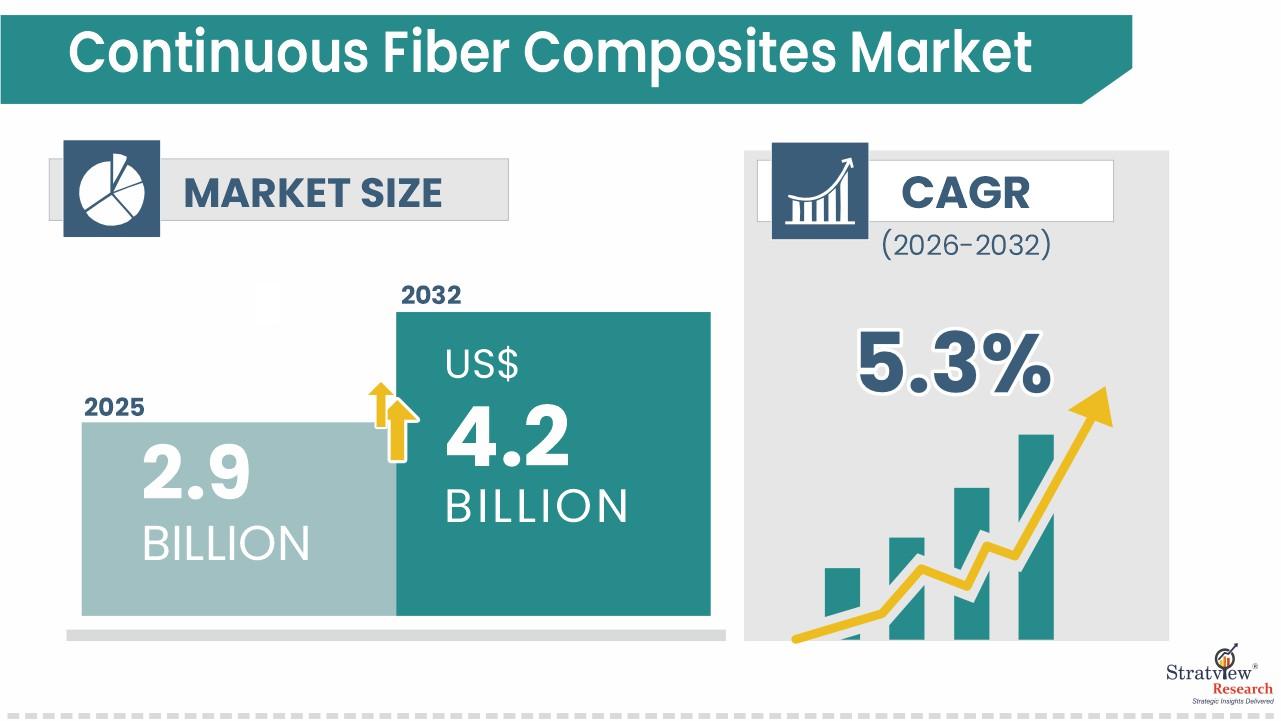
The Continuous Fiber Composites Market was estimated at USD 2.9 billion in 2025 and is likely to grow to USD 4.2 billion in 2032. The market is projected to grow at a CAGR of 5.3% during 2026-2032. The Continuous Fiber Composites Market is expected to grow at a CAGR of 5.3% during 2026-2032. This market intelligence reflects rising demand for lightweight, high-performance materials across composite-rich end-use industries.
The growth trajectory is linked to the organic growth of automotive and aerospace & defense, stringent government regulations regarding fuel efficiency enhancements and carbon emission reductions, and superior performance over traditional metals. The Continuous Fiber Composites Market growth is also supported by the increasing use of glass and carbon fibers across applications. Stratview states that both fibers are increasingly used because of their distinct advantages.
Request a free sample report:
https://www.stratviewresearch.com/Request-Sample/Continuous-Fiber-Composites-Market#form
Market Segmentation Analysis
By Form Type, the Continuous Fiber Composites Market is segmented into Woven Fabrics, Non-Crimp Fabrics, Unidirectional Tape, and Others. Woven fabric is projected to remain the most dominant form type during the forecast period, driven by high usage in wind energy, automotive, and electronics. Non-Crimp Fabrics occupied a considerable market share because of increased usage in wind energy. Unidirectional Tape is likely to be the fastest-growing market, supported by aerospace & defense and automotive traction.
By Resin Type, the market is segmented into Thermoset Composites and Thermoplastic Composites. By Reinforcement Type, the market is segmented into Glass Fiber Composites, Carbon Fiber Composites, and Other Fiber Composites. Glass Fiber Composites are projected to remain the most dominant segment because of low cost, good mechanical performance, and excellent corrosion and abrasion resistance. Carbon Fiber Composites are likely to witness the highest growth, supported by lightweighting demand and cost-reduction efforts.
By End-Use Industry Type, the market is segmented into Aerospace & Defense, Automotive, Wind Energy, Sporting Goods, Electronics, and Others. Wind Energy is likely to maintain dominance in the total market during the forecast period. Demand is linked to wind blades, spinners, and nacelles, which are major composite applications. Aerospace & Defense and Automotive are likely to be the fastest-growing markets, driven by increasing penetration of composites in structural to semi-structural applications.
By Region, the market is segmented into North America, Europe, Asia-Pacific, and Rest of the World. Asia-Pacific is likely to remain the largest market during the forecast period, and Europe is likely to witness the highest growth during the same period. This regional analysis shows how demand is shaped by end-use industry concentration, aircraft-related activity, automotive production, wind turbine installations, and advanced composite use in premium and electric vehicles.
Regional Market Insights
Asia-Pacific is likely to remain the largest market during the forecast period, driven by China, India, and Japan. Stratview identifies high installations of wind turbines, high automobile production, high electronic parts manufacturing, upcoming indigenous commercial and regional aircraft, and the opening of Boeing and Airbus assembly plants in China as major factors. This demand mix gives Asia-Pacific a wide application base across energy, automotive, electronics, and aerospace-related manufacturing.
Europe is likely to witness the highest growth during the same period, driven by aerospace & defense and automotive industries. Europe is the manufacturing capital of premium and electric vehicles, where advanced composites are gaining traction. Major premium and electric automakers are increasing composite content to address EU carbon emission reduction norms. Increasing production rates of the A350XWB and A320 family, including neo versions, are also likely to support regional demand.
Emerging Trends Shaping the Continuous Fiber Composites Market
The Continuous Fiber Composites Market industry trends reflect a wider shift toward material systems that balance strength, weight, durability, and cost. Stratview notes that composite selection depends on application requirements, including part strength, part cost, part geometry, and part complexity. This creates a structured demand environment where continuous fiber composites support industries that need performance consistency and material efficiency across varied manufacturing processes.
A second trend is the differentiated growth of material forms and reinforcement types. Woven Fabrics remain dominant, Unidirectional Tape is likely to grow fastest, Glass Fiber Composites remain dominant, and Carbon Fiber Composites are likely to witness the highest growth. This competitive landscape shows that demand is not moving in one direction only. Instead, users are selecting materials based on cost sensitivity, lightweighting needs, corrosion resistance, mechanical performance, and application-specific requirements.
Key Growth Drivers of the Market
- Composite-rich industries such as automotive and aerospace & defense are expanding continuous fiber composite use in applications requiring stronger lightweight materials.
- Fuel efficiency enhancement regulations increase the need for lighter material systems, encouraging OEMs to introduce composite-rich vehicles and aircraft.
- Carbon emission reduction requirements support higher composite content, especially where weight reduction improves performance and regulatory alignment.
- Superior performance over aluminum and steel supports adoption in industries requiring corrosion resistance, creep resistance, low maintenance cost, and strength-to-weight efficiency.
- Wind Energy demand supports market growth because wind blades, spinners, and nacelles are major applications largely fabricated with glass fiber composites.
Competitive Landscape
Top Companies in the Market
- Owens Corning Corporation
- Saertex GmbH & Co. KG
- Sekisui Jushi Corporation
- Chomarat Group
- Hexcel Corporation
- Toray Industries
- SABIC Corporation
Conclusion and Strategic Outlook
The Continuous Fiber Composites Market is likely to advance from USD 2.9 billion in 2025 to USD 4.2 billion in 2032, expanding at a CAGR of 5.3% during 2026-2032. The industry outlook remains anchored in composite penetration across wind energy, automotive, aerospace & defense, electronics, and sporting goods. Market forecast signals point to steady demand from lightweighting, corrosion resistance, fuel efficiency, carbon emission reduction, and performance advantages over traditional metals.
FAQs – Continuous Fiber Composites Market
What is the size of the Continuous Fiber Composites Market?
The Continuous Fiber Composites Market was estimated at USD 2.9 billion in 2025. It is likely to reach USD 4.2 billion in 2032.
What CAGR is expected for the Continuous Fiber Composites Market?
The Continuous Fiber Composites Market is likely to grow at a CAGR of 5.3% during 2026-2032. The growth rate reflects rising composite adoption across key end-use industries.
What factors are driving Continuous Fiber Composites Market demand?
Demand is driven by organic growth in composite-rich end-use industries, fuel efficiency requirements, carbon emission reduction regulations, and superior performance over aluminum and steel. Lightweight properties and corrosion resistance also support adoption.
Which region is expected to dominate the Continuous Fiber Composites Market?
Asia-Pacific is likely to remain the largest market during the forecast period. China, India, and Japan are identified as key contributors, supported by wind energy, automotive, electronics, and aircraft-related activity.
What is the strategic outlook for the Continuous Fiber Composites Market?
The strategic outlook is positive, with demand linked to material performance and end-use industry growth. Companies may evaluate opportunities across dominant and high-growth segments, including Woven Fabrics, Unidirectional Tape, Glass Fiber Composites, Carbon Fiber Composites, Wind Energy, Aerospace & Defense, and Automotive.

 Arabic
 French
 Spanish
 Portuguese
 Deutsch
 Turkish
 Dutch
Dutch
 Italiano
 Russian
 Romaian
 Portuguese (Brazil)
 Greek
Greek